 Basem Rajjoub
Padé Approximants: The Hidden Gem of Rational Approximation
Contents
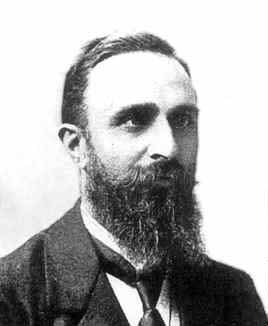 Henri Padé (1863–1953) [4]
Taylor series approximate a function with a polynomial. Padé approximants use the same coefficients but form a ratio of two polynomials. This lets them capture poles and branch points, and converge where Taylor diverges.
The Padé approximant
Given $f(x) = c_0 + c_1 x + c_2 x^2 + \cdots$, the $[L/M]$ Padé approximant is
\[R_{[L/M]}(x) = \frac{a_0 + a_1 x + \cdots + a_L x^L}{1 + b_1 x + \cdots + b_M x^M} \tag{1}\]whose Taylor expansion matches $f(x)$ through order $L + M$:
\[R_{[L/M]}(x) = c_0 + c_1 x + \cdots + c_{L+M} x^{L+M} + \mathcal{O}(x^{L+M+1}) \tag{2}\]Equating coefficients in (1) gives a linear system for the $b_j$, then explicit formulas for the $a_k$. The total number of parameters is $L + M + 1$, the same as a degree-$(L+M)$ polynomial, but the denominator can vanish, letting the approximant represent singularities.
Interactive comparison
Compare Taylor and Padé with independent slider controls:
Practical examples
1. Integrating $\ln(1+x)$ beyond convergence
\[I = \int_0^3 \ln(1+x)\,dx = 4\ln 4 - 3 \approx 2.5452 \tag{3}\]The series $\ln(1+x) = x - x^2/2 + x^3/3 - \cdots$ converges only for $\lvert x \rvert \le 1$. At $x = 3$ the polynomial blows up:
\[\text{Taylor } T_6: \quad \int_0^3 T_6\,dx \approx -33.17 \quad (1403\%\text{ error, wrong sign})\]The $[3,3]$ Padé from the same 7 coefficients:
\[R_{[3,3]}(x) = \frac{x(11x^2 + 60x + 60)}{3(x^3 + 12x^2 + 30x + 20)}\] \[\int_0^3 R_{[3,3]}\,dx \approx 2.5435 \quad (0.07\%\text{ error})\]The rational integral evaluates in closed form via partial fractions.
2. Differentiating $1/\sqrt{1+x}$
\[f(x) = \frac{1}{\sqrt{1+x}}, \qquad f'(x) = -\frac{1}{2}(1+x)^{-3/2} \tag{4}\]Exact: $f’(2) \approx -0.0962$. The $[2,2]$ Padé from 5 coefficients:
\[R_{[2,2]}(x) = \frac{x^2 + 12x + 16}{5x^2 + 20x + 16}\] \[\text{Taylor } T_4': \quad f'_T(2) \approx 6.0 \quad (\text{diverged, wrong sign})\] \[\text{Padé } [2,2]': \quad f'_P(2) \approx -0.0942 \quad (2.1\%\text{ error})\]The Padé captures the branch point at $x = -1$. Its derivative (via quotient rule) is again rational.
3. Cantilever with singular load
A cantilever of length $L$ carries a distributed load with a square-root singularity at the free end:
\[q(\xi) = \frac{q_0}{\sqrt{1 - \xi}}, \qquad \xi = x/L \tag{5}\]The Euler-Bernoulli deflection satisfies
\[EI\,w^{(4)}(\xi) = \frac{q_0}{\sqrt{1-\xi}} \tag{6}\]The Taylor series of the load converges only for $\lvert\xi\rvert < 1$, so the polynomial diverges at the tip. Replacing the load by its Padé approximant before integrating keeps the deflection accurate across the full span:
Set Taylor to $T_5$ and Padé to $[3,2]$: same 6 coefficients, but the Padé deflection tracks the exact curve while Taylor underestimates the tip displacement.
Why rational functions are practical
| Operation | Polynomial | Rational function |
|---|---|---|
| Evaluate | Horner’s method | Horner on numerator and denominator, one division |
| Differentiate | Power rule | Quotient rule, result is rational |
| Integrate | Term by term | Partial fractions, then log/arctan terms |
| Capture poles | Cannot | Denominator zeros model singularities |
References
- Baker, G. A. & Graves-Morris, P. (1996). Padé Approximants, 2nd ed. Cambridge University Press.
- Bender, C. M. & Orszag, S. A. (1999). Advanced Mathematical Methods for Scientists and Engineers. Springer.
- Gonnet, P., Güttel, S. & Trefethen, L. N. (2013). Robust Padé approximation via SVD. SIAM Review, 55(1), 101–117.
- Portrait of Henri Padé. Wikimedia Commons, public domain. Source.
